La Dolce Vita Fashion Fellini Interviews
F or a dizzying moment in the disorientated postwar era, cinema and Federico Fellini put Rome at the centre of the globe; now his early masterpiece from 1960, La Dolce Vita, is rereleased as function of a retrospective at London's BFI Southbank to mark the 100th anniversary of his birth. It'southward a film with Fellini's genius for revealing dreamlike and surreal images everywhere, especially that extraordinary image of Christ beingness helicoptered over the metropolis, apparently on its fashion to be delivered to the pope.
The movie finds Rome in a hysterical, excitable simply besides somehow drastic mood – the mood of "Il Blast", that economic and cultural revival in which Italy was euphorically eager to forget the catastrophe of fascism and defeat, and to start all over over again, in a headlong rush of modernity and excitement: movies, music, style and fashion. It is as if Rome'southward new contemporary sexiness and hedonism has revived the spirit of pre-Christian Rome and pagan ritual. But this coexists with a underground melancholy, a spiritual bust to go with the boom: ennui and fear.
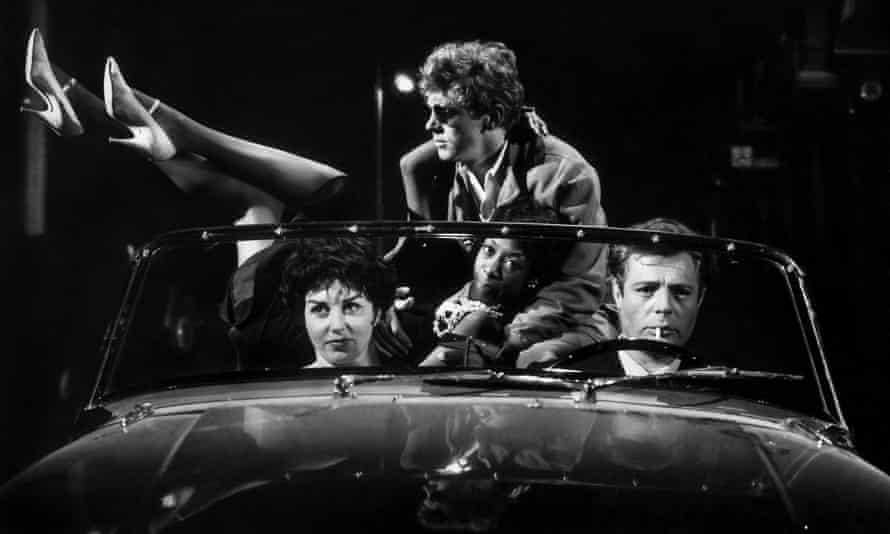
Marcello Mastroianni plays Marcello, a handsome and jaded gossip journalist who is a man nearly boondocks, a night owl, a womaniser whose affairs bulldoze his regular girlfriend Emma (Yvonne Furnaux) to despair. Nearly importantly, he is an habitué of the fashionable Via Veneto, where Hollywood and Italian motion picture stars are routinely surrounded by aggressive photographers; here is where Marcello's own colleague, Paparazzo (Walter Santesso), gave the world a new give-and-take. (When Marcello addresses him crisply as "Paparazzo!" it now sounds accusing in an unintentional manner.) For shooting nighttime scenes, Fellini created a gigantic full-scale replica of the Via Veneto at the Cinecittà studios, and Shawn Levy's volume about Rome in this period, Dolce Vita Confidential, amusingly describes how Fellini came to prefer his own artificial Via Veneto – larger, straighter – to the real thing.
Marcello despises himself for having failed to write a novel, and he is actually acquainted with a serious and much-lauded author known simply equally Steiner (played by Alain Cuny), that name perhaps signalling a Mitteleuropaïsch seriousness at odds with Rome's carefree world. It is Steiner who is to be the touchstone of Marcello'due south fragile idealism, his sense that he might one day brand something of himself; and information technology is Steiner'southward awful fate that is to seal Marcello'southward disillusion: especially the way the paparazzi behave effectually his widow.
Is Marcello a damned soul? In that location is a whiff of sulphur in his relationship with Maddalena (Anouk Aimée), whose proper noun perhaps recalls Mary Magdalene, especially when at the end of a long evening they go off together with a sex worker to her wretched flat to have sex activity there, for the low-life thrills. (The woman hopes that Marcello might give her 2,000 lire in the morning time; he does not.)
Fellini contrives an amazing sequence when Marcello has to encompass a spasm of religious hysteria when 2 children are reported to accept had a vision of the Blest Virgin: an impromptu media circus convenes as the sick and the disabled arrive en masse, hoping to be cured. And it is disturbing and even moving when Marcello's handsome and roguish old begetter (Annibale Ninchi) arrives in Rome without alert and Marcello takes him for a night on the town; the older human being charms the local young women, one of whom – to Marcello'southward consternation and dismay – takes him habitation to her flat.
At that place is an excruciating and mortifying sequel every bit his father suffers some kind of medical crunch, brought on, we can simply presume, by incautious exertion, or the prospect of exertion. Marcello has to come circular to this woman's identify to get him a taxi – having already confessed to a friend that he doesn't even know his father very well. He sees in him a picture of both his future and present cocky. (Paolo Sorrentino'due south ageing journalist Jep in his 2013 motion picture The Great Beauty, played by Toni Servillo, is in some mode a conflation of Marcello and his begetter.) In that location is something so sad in it.
An extended sequence in a 16th-century castle as the invitee of a decadent and financially ruined aristocratic family is the prelude to a gloomy twilight of Marcello's self-respect. It is a comparable, lugubrious mood that Antonioni found in his movie La Notte a yr later. More parties lead to that foreign beach confrontation with the fish, a sea monster that is a portent of disaster.
La Dolce Vita is widely remembered for Marcello gallantly disporting himself in the Trevi fountain with the visiting Hollywood diva Sylvia (Anita Ekberg), a scene that might be simply too preposterous, were information technology not for the inspired ending that Fellini conjures. Of a sudden, similar a hard cut, night turns to morning, like awakening from a dream, and the pair are even so fully clothed in the fountain, blinking in the daylight. Accept they actually been like that, all nighttime, or is the whole thing a dream? And the press interview scene is baroque, with Sylvia asked whether she prefers pyjamas or a nightgown, or if she thinks neorealism is dead.
Like the interview scenes in Godard's Breathless that same year, it shows a fascination with the theatre of celebrity. It is a bright film, but there is nothing sweet about information technology.
0 Response to "La Dolce Vita Fashion Fellini Interviews"
Post a Comment